Brand
Food Should Taste Good
Carrot Ginger Bisque Soup
Creamy Tomato & White Cheddar Bisque Soup

Multigrain Black Bean Chips
Cantina tortilla chips
Blue Corn Tortilla Chips
Blue Corn Tortilla Chips

Multi grain Tortilla Chips
Multigrain Tortilla Chips
Multigrain Tortilla Chips
Sweet Potato Tortilla Chips
Tortilla chips
Tortilla Chips, Lime
Tortilla chips, made with pumpkin, cinnamon and nutmeg
Classic Mediterranean Hummus
Lemon & olive tapenade hummus
Black Bean Multigrain Bean Chips
Fd shd tst gd ktl cked sweet pot chips original
Food Should Taste Good Olive Tortilla Chips
Food should taste good, brown rice crackers, roasted red pepper
Food should taste good, brown rice crackers, tomato & basil
Guacamole Tortilla Chips
Tortilla Chips
Tortilla Chips
Tortilla Chips
White Bean Hummus
Black Beans Hummus
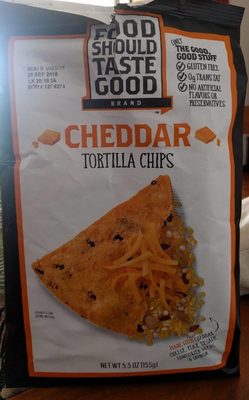
Cheddar Tortilla Chips
Curry & mini chutney hummus
Edamame Hummus
Brown Rice Crackers, Sea Salt
Gouda Crisps
Original Sweet Potato Chips
Peppercorn Blend Brown Rice Crackers
Multigrain Pita Puffs
Pita puffs
Pita puffs
Pita Puffs
Food should taste good, tortilla chips, jalapeno, cheddar
Real good bar
Real Good Bar
Real Good Bar, Hazelnut Sea Salt
Real Good Bar, Macadamia Chai
Pita crackers simply sea salt
About Food Should Taste Good on Looksee
Looksee tracks 43 products from Food Should Taste Good in the catalogue. Across the 42 scored products, the average Looksee Score is 47/100 (Fair).
Score breakdown: Fair (26), Poor (12), Good (4). Highest-scoring: Carrot Ginger Bisque Soup at 77/100. Lowest-scoring: Real Good Bar, Macadamia Chai at 25/100.
Nutri-Score grades in this catalogue: C (14), D (14), E (8), A (3), B (2).
Processing level (NOVA classification): Group 3 — Processed food (25), Group 4 — Ultra-processed food (16).
Category: food (43).
Every Looksee Score combines three independently validated signals into one 0–100 number, where higher is always better: Nutri-Score (nutrition quality — calories, saturated fat, sugar, and salt weighed against fibre and protein, up to 40 points), NOVA classification (degree of industrial processing, from unprocessed to ultra-processed, up to 35 points), and additive risk (a risk-weighted penalty for ingredients flagged by EFSA or peer-reviewed studies, up to 25 points). If a pillar has no data for a given product, it is dropped from both the numerator and denominator so the product is never penalised for a data gap. See the full scoring methodology →